Before and after the show
A Gion evening around the kenbu show
How to build an evening in Gion around the kenbu hour, from a walk beside the Shirakawa canal to the manners Kyoto asks of visitors in the district.
Book the kenbu show ↗Where the theatre sits
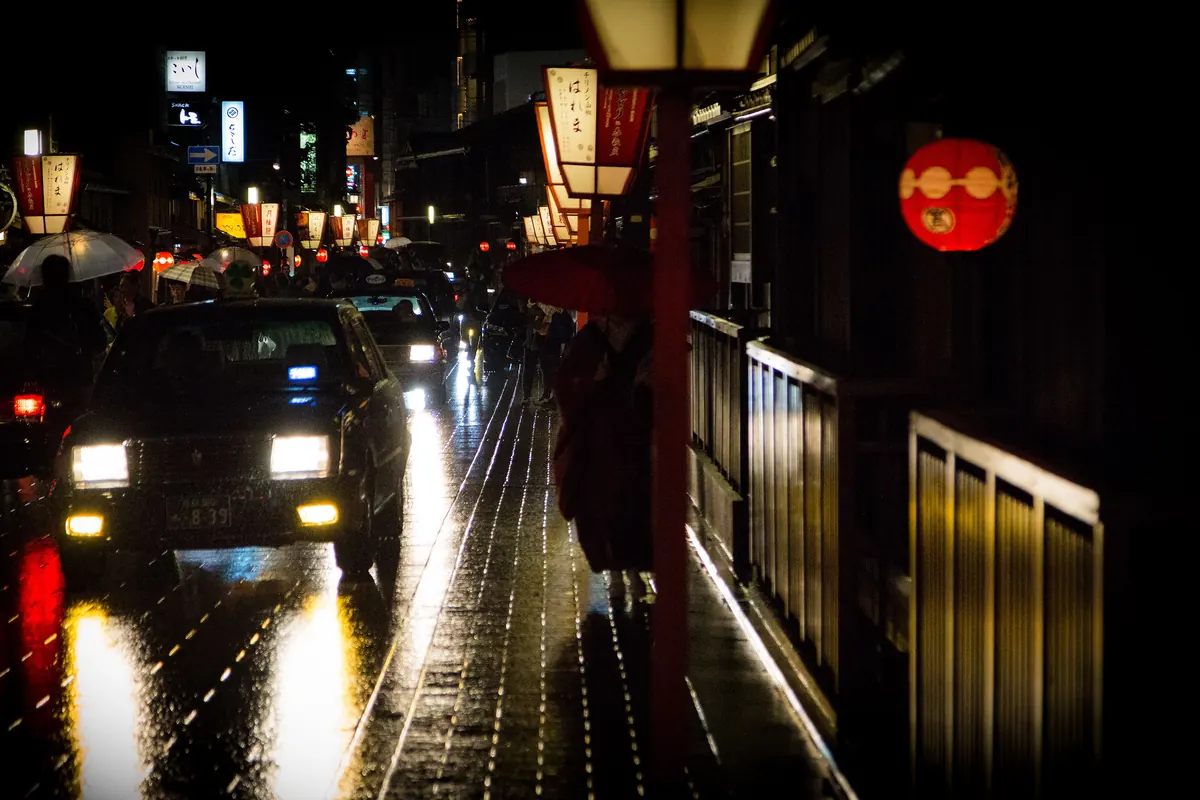
The Samurai Kenbu Theater is in Higashiyama ward, in the Sanjō–Hanamikōji part of town, on the basement level of the Gozan building. Higashiyama lies between the Kamo River and the eastern hills, and Gion is its entertainment district, in front of Yasaka Shrine. Gion began in the Sengoku period to serve travellers visiting the shrine. That is an era that shaped kenbu's forms, so the walk to the theatre passes through the same story.
What Gion is
Gion is made of old streets of wooden machiya townhouses, some now restaurants and shops selling Kyoto sweets and crafts, and part of it is a designated national historic preservation district. It has two geisha districts, Gion Kobu, the larger, which includes Hanamikōji street, and the smaller Gion Higashi. Kyoto geisha are called geiko locally. The district was once a major centre for kabuki, and of its six theatres only one survives. It is also a nightlife area, especially along Shijō Street.
Hanamikōji street
Hanamikōji is the famous street in Gion Kobu. It runs south from Shijō Street, where it is anchored by Ichiriki Tei, down to Kennin-ji temple. Since 1986 the city has been removing electric poles from Hanamikōji and two other historic streets. The street is not pedestrian-only, so cars share it with walkers, and the city asks visitors to avoid walking in the middle of the road.
A walk before the show
The Shirakawa, before it joins the Kamo, has a preserved stretch with traditional establishments lining its south side. The north side was cleared during the Second World War as a fire break and is now a pedestrian street lined with cherry trees, lit in the evening in spring. The Japan National Tourism Organization suggests seeing the Shirakawa canal by lantern light. Allow time to wander slowly, and arrive at the theatre for your slot, because it has no waiting room. Gion's two districts also stage seasonal dances, the Miyako Odori, which dates from 1872, in spring and the newer Gion Odori in early November.
The manners Gion asks for
Kyoto's tourism office publishes the rules, and they are firm. Don't stop, touch, follow or take unauthorised photos or videos of geiko and maiko. Don't enter temples, shrines or private property that are not shops or roads. Don't loiter on the pavement or block the road, because Hanamikōji is not a pedestrian-only street. Don't litter, and don't make loud noise. Penalties exist for several of these, including fines for obstruction and trespass. A good rule is to behave as if the street were a neighbour's front garden.
Seeing geiko and maiko the right way
If you hope to see geiko or maiko, the city's tourism guide recommends public dance performances and the paid options it names, not hunting for them in the lanes. Photography of maiko without permission is strictly prohibited, and approaching one who is hurrying to an engagement is a nuisance. The kenbu show is a different kind of Gion evening, one built around samurai poetry and swords, so it won't replace that. It is a separate hour, best treated as one.
Getting around without a subway stop
Gion has no subway station of its own. The Japan National Tourism Organization says Gion-Shijō and Kyoto Kawaramachi stations are a short, scenic walk away, and buses from Kyoto Station stop in front of Yasaka Shrine. For the theatre, its own access page recommends the Tōzai subway line to Sanjō-Keihan, then a short walk.
After the show
Dinner nearby is easy to find: Gion has traditional restaurants and teahouses, Japanese and foreign restaurants, bars and cafes. Eat after the hour, as the ticket doesn't include food or drinks. A drum show near Kawaramachi is a different way to spend another evening in Kyoto, and it welcomes photos and video, which the kenbu show does not.
Sources